
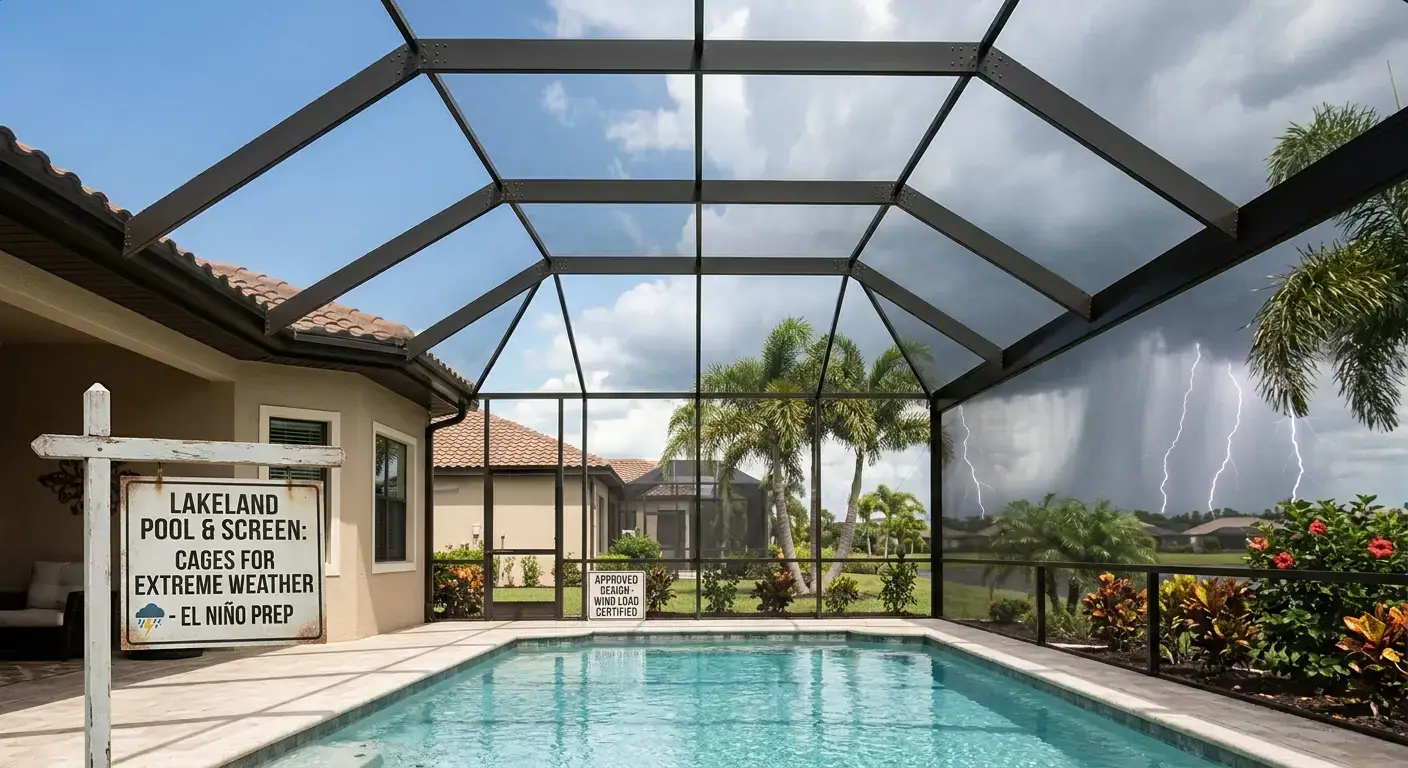
We’ve spent the last week digging through storm data and building codes after a stalled low-pressure system left up to 6 inches of rain accumulated on parts of Polk County. What we found surprised us: the pool cage industry has a perception problem, and it’s about to collide with a winter forecast that NOAA says could rival the strongest El Niño since 1950. Here’s what homeowners in Lakeland need to know before the next system rolls through.
Three Surprising Findings
Finding 1: The screen is designed to fail, and that’s not a defect.
Florida Building Code section 2002.7 allows engineers to design screen enclosures with panels that are removed, retracted, or cut when forecast winds exceed 75 mph. The mesh acts as a sacrificial element. When screens blow out, wind passes through the frame instead of tearing the cage from its anchors. Most homeowners see missing screens and assume structural failure. In many cases, the frame did exactly what it was engineered to do.
Finding 2: The incoming El Niño brings rain and a higher historical tornado count.
NOAA places Florida in a wetter-than-average zone for December 2026 through February 2027. Historical data from the National Weather Service shows Central and South Florida experience nearly twice as many tornado events during El Niño winters. The February 22 to 23, 1998 Central Florida outbreak had seven confirmed tornadoes in the NWS Melbourne forecast area and 42 deaths. Pool cages face both prolonged moisture exposure and episodic wind events that test installation quality.
Finding 3: Rescreening an intact frame generally costs less than rebuilding.
Prices vary by screen area, height, access, mesh, and frame condition. An inspection after a storm keeps a rescreen from turning into a rebuild when bent members or loose anchors would make new mesh the wrong first step.
Key Findings
- Up to 6 inches of rain accumulated in parts of Polk County during the November 2, 2026 event. NWS meteorologist Stephen Shiveley said the heaviest amount west of downtown Lakeland was about 3.5 inches.
- NOAA’s winter outlook places Florida in the wetter-than-average zone for December 2026 through February 2027.
- An 83% chance exists that the current El Niño will exceed the strength of previous events dating back to 1950, per NOAA’s October 2026 discussion.
- The 1997 to 98 Super El Niño brought Florida its wettest November to March period on record, with flooding and severe weather affecting multiple regions.
- Central and South Florida average nearly twice as many tornado events during El Niño winters compared to non-El Niño winters, per NWS historical data.
- The February 22 to 23, 1998 outbreak produced seven confirmed tornadoes in the NWS Melbourne forecast area, killing 42 people and damaging or destroying thousands of structures.
- Florida Building Code section 2002.7 permits screen-removal design alternates. The contractor must give the owner written notice to retract, remove, or cut the designated panels when winds are expected to exceed 75 mph.
- Flood advisories on November 2 covered Lakeland, Plant City, Winter Haven, Bartow, Lake Wales, and Auburndale as heavy rain moved across the county.
What This Means for Lakeland Homeowners
If you own a pool cage in Polk County, NOAA’s outlook favors more rain this winter. The frame, the anchors, and the connections are what to check. Repeated wet weather can loosen fasteners and hide corrosion, and a bent upright is not always visible from the yard. Missing screen can be the mesh doing what an approved design allows, or it can sit on a frame that has moved. An inspection after a storm keeps a rescreen from turning into a rebuild.
Expert Quote
Issac Turpin, Founder and CEO of True Corp:
“After every storm we get calls from homeowners who think their cage failed because the screens are gone. In most cases, the frame did exactly what the code allows it to do, it shed the mesh to protect the structure. The real question is whether the anchors and connections are still sound. With a Super El Niño winter ahead, that inspection should happen before the next system, not after.”
Methodology
This analysis draws from NWS Tampa Bay advisories, NOAA’s winter outlook and October ENSO discussion, NWS 1998 assessments, Florida Building Code chapter 20, the Angi cost guide, and the aol.com weather report on the November 2, 2026 Polk County rain.
About True Aluminum
True Aluminum is a family-owned aluminum contractor serving Central Florida since 2009, part of the True family of companies. Fully licensed (FL License SCC131151391). The True family has served 100,000+ customers. Google reviews on the Lakeland profile are 4.9 stars from 300+ reviews. Services include pool cages, screen enclosures, sunrooms, carports, pergolas, and outdoor kitchens.
Read the complete analysis: Pool Cage Installation Lakeland Prepares for Polk Flooding and Super El Niño.
Explore our pool cage installation services in Lakeland: True Aluminum Pool Cages.
