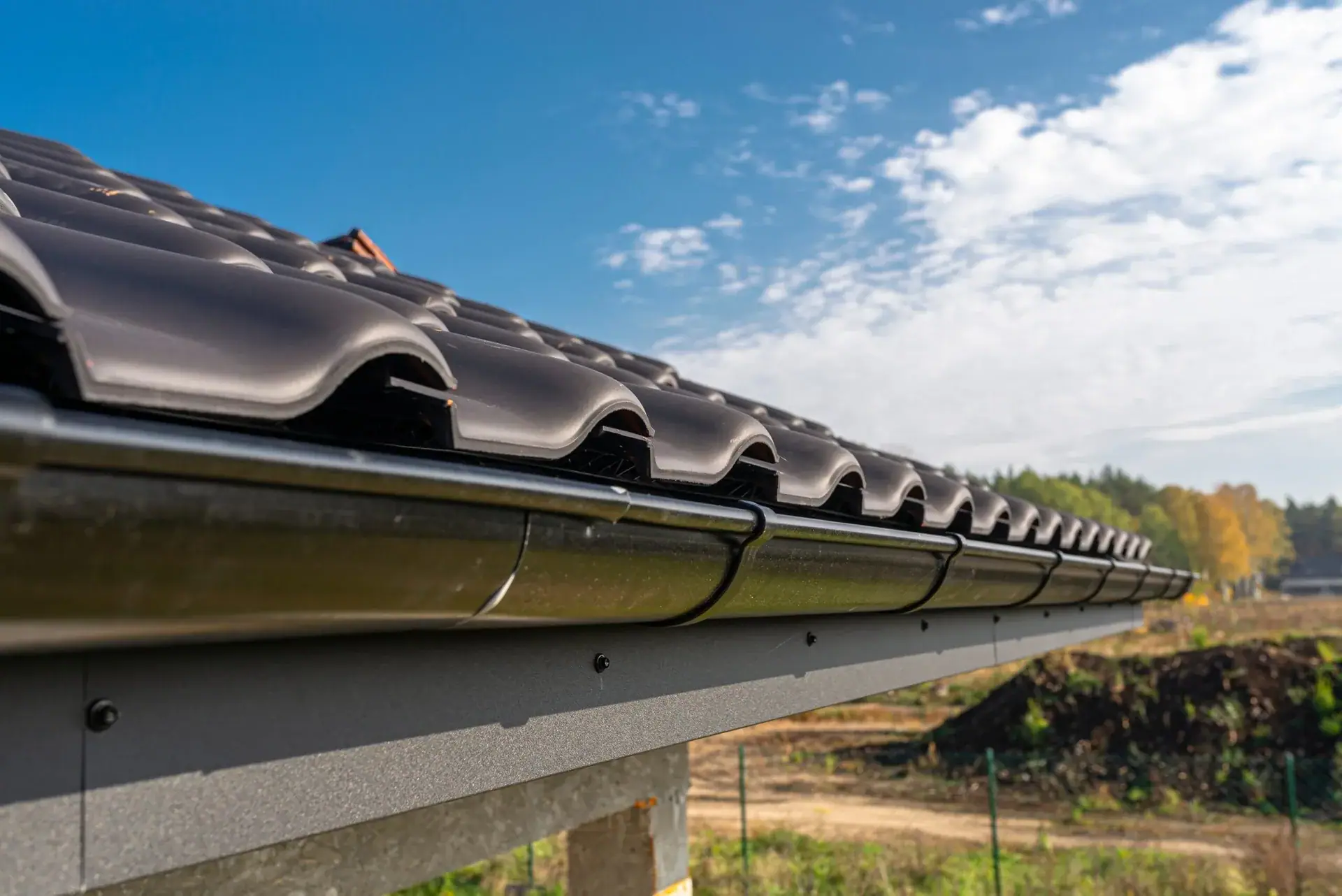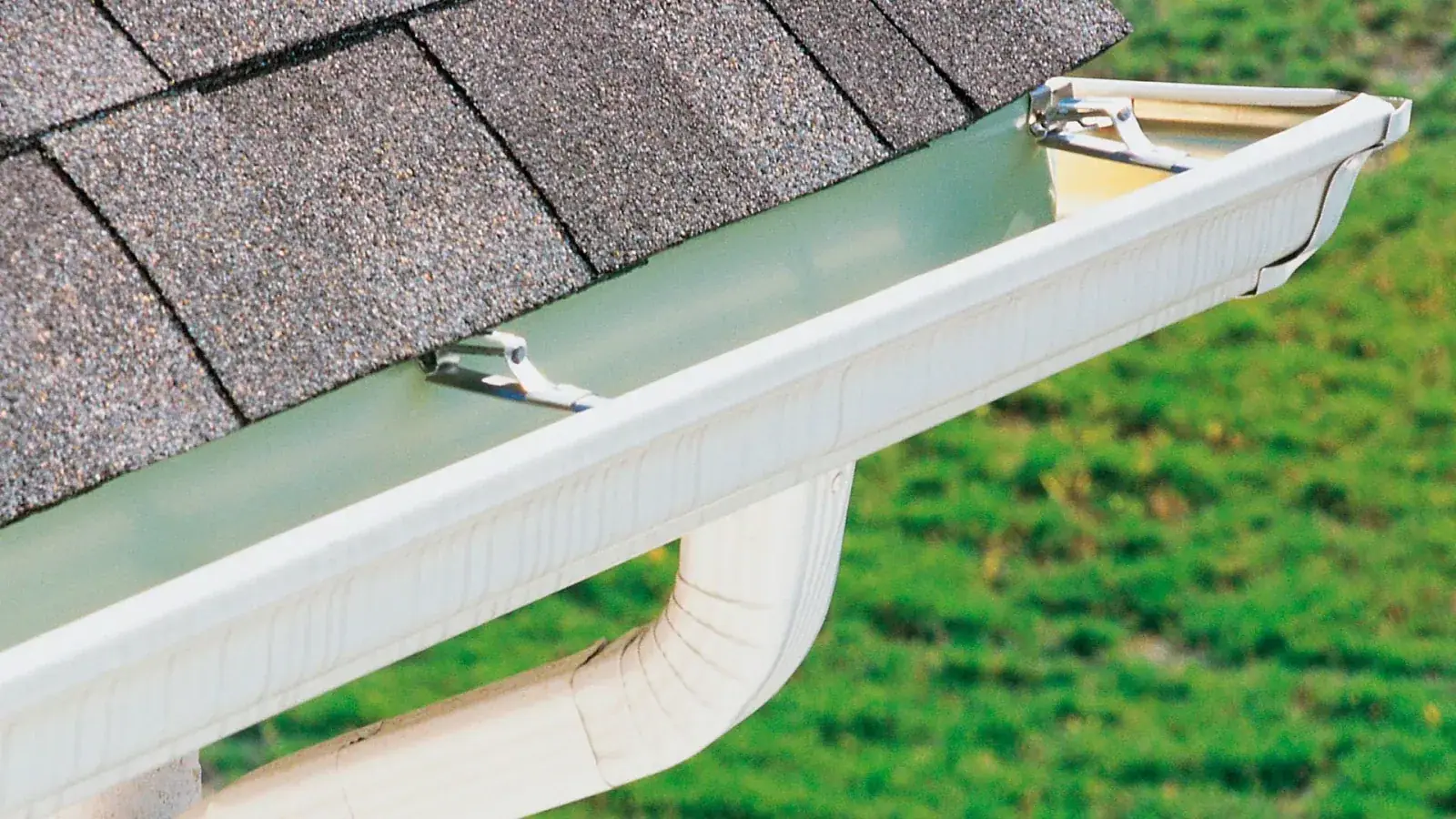
House gutters at True Aluminum are 5 inch or 6 inch K-style. We cut them on site. A pool cage super gutter is a different piece, and it can be larger. This post is the house trough.
What we measure
We do not pick the size from the street. We measure the roof planes, the pitch, the length of each run, where each outlet discharges, and what the fascia can carry.
A small hip on a one-story house is not the same run as a valley that dumps two planes into one wall. That valley is the usual reason one side overflows while the rest of the house looks fine. We size that run on its own. The other walls can stay 5 inch.
When 5 inch is the run
One-story roofs usually take 5 inch. The trough is the residential size we hang when the plane is modest, the run is not long, and the water has an outlet before it stacks up in the middle.
Five inch is not a cheap version of the job. It is the size that matches that roof. Hanging 6 inch on a short, low plane adds aluminum you do not need. We say so at the measure.
When 6 inch is the run
Steep roofs, long runs, and big roof planes take 6 inch, because an August storm moves more water than a 5 inch trough can carry.
A steep roof sends the water faster. A long run has to hold that water until it reaches an outlet. A big plane collects more of the storm in one place. Any one of those can be the reason we step up. Two of them together is a clearer case.
We still look at the fascia. A heavier trough needs wood that will hold the hangers. If the board is soft, the size conversation waits until the wood is fixed. New metal does not go on rotten board.
Cut on site
The gutter is formed on the driveway and cut to the roof. It is not a stack of pre-made sticks spliced along the fascia. The only joints on a seamless run are at the corners and the outlets.
Color matches the trim, or the frame of a screen enclosure if you want the metal on the house to read as one piece. Hidden hangers hold the pitch. The pitch is a small fall toward each outlet. A gutter that looks dead level from the yard holds a pond, and the size will not fix a flat run.
The outlet still matters
A 6 inch trough that dumps beside the slab still leaves a puddle. A downspout that empties beside the concrete can leave the same puddle even after the gutter above it is replaced.
We ask where the water lands. Pool decks, walks, and the dirt at the foundation are the places a bad outlet shows up. Extensions carry the discharge off the concrete. Inside a screen enclosure, the outlet belongs outside the screen.
If the house, a lanai, and a pool cage all shed onto one corner, one downspout cannot take three roofs. We split the runs. The cage beam is the super gutter. It is not this 5 inch or 6 inch choice.
Two stories, trees, and the fascia
A two-story house uses the same coil. The difference is access and a longer drop. The hangers still have to find wood, not only the decorative trim under the soffit. If the screws will not bite, the edge is rebuilt before we argue about 5 inch or 6 inch.
Oaks and pines pack a gutter here. Catkins and needles sit in the trough and hold water. A guard keeps the big debris on the roof. It does not make the gutter maintenance-free. Fine grit still settles. A guard is worth talking about on a two-story, where the ladder is the hard part. On a roof with almost no canopy, we will say the guard is optional.
White chalk that wipes off on your hand means the coating is gone. Stains on the stucco under the eave mean water has been missing the trough. Age alone is not the test. A gutter that still pitches and still holds water can stay, even if a neighbor’s new 6 inch run looks newer from the street.
Repair or a new size
Sagging between hangers, on sound wood, is often a rehang. The hangers pulled out or they were too far apart. That is not automatically a 6 inch replacement.
Overflow in the middle of a run, on a roof with a long plane or a steep pitch, is the size conversation. Overflow only at a corner is often a clogged outlet or too few downspouts. A new trough does not fix a corner that only needed a cleanout.
Seams on an old sectional gutter are a different problem. Those joints open. A seamless replacement is the argument there, and the size is still chosen from the roof, not from the old stick.
What we will not put in this post
We do not print a flow rate. We do not print a downspout size. We do not print a price. Footage, story height, tear-off, fascia repair, and the step from 5 inch to 6 inch are lines on a written estimate. They are not a number on a blog.
Market ranges, labeled as market ranges and not a True Aluminum quote, are on the Lakeland gutter cost page: what gutter installation costs in Lakeland. How long the aluminum lasts is on how long aluminum gutters last in Florida.
Where the pages are
New installs are gutter installation. A tear-off of a failed run is seamless gutter replacement. Outlets and extensions, when the trough is already sound, are gutter downspouts and drainage.
We hang these runs in Lakeland, Plant City, and the other cities that already have pages on this site. The shop is 4000 N Frontage Rd, Plant City, FL 33565. The Lakeland office is 2829 Badger Rd #19, Lakeland, FL 33811.
License SCC131151391. Call (863) 804-6021. Tell us which wall overflows. We will not quote a size from a description alone.