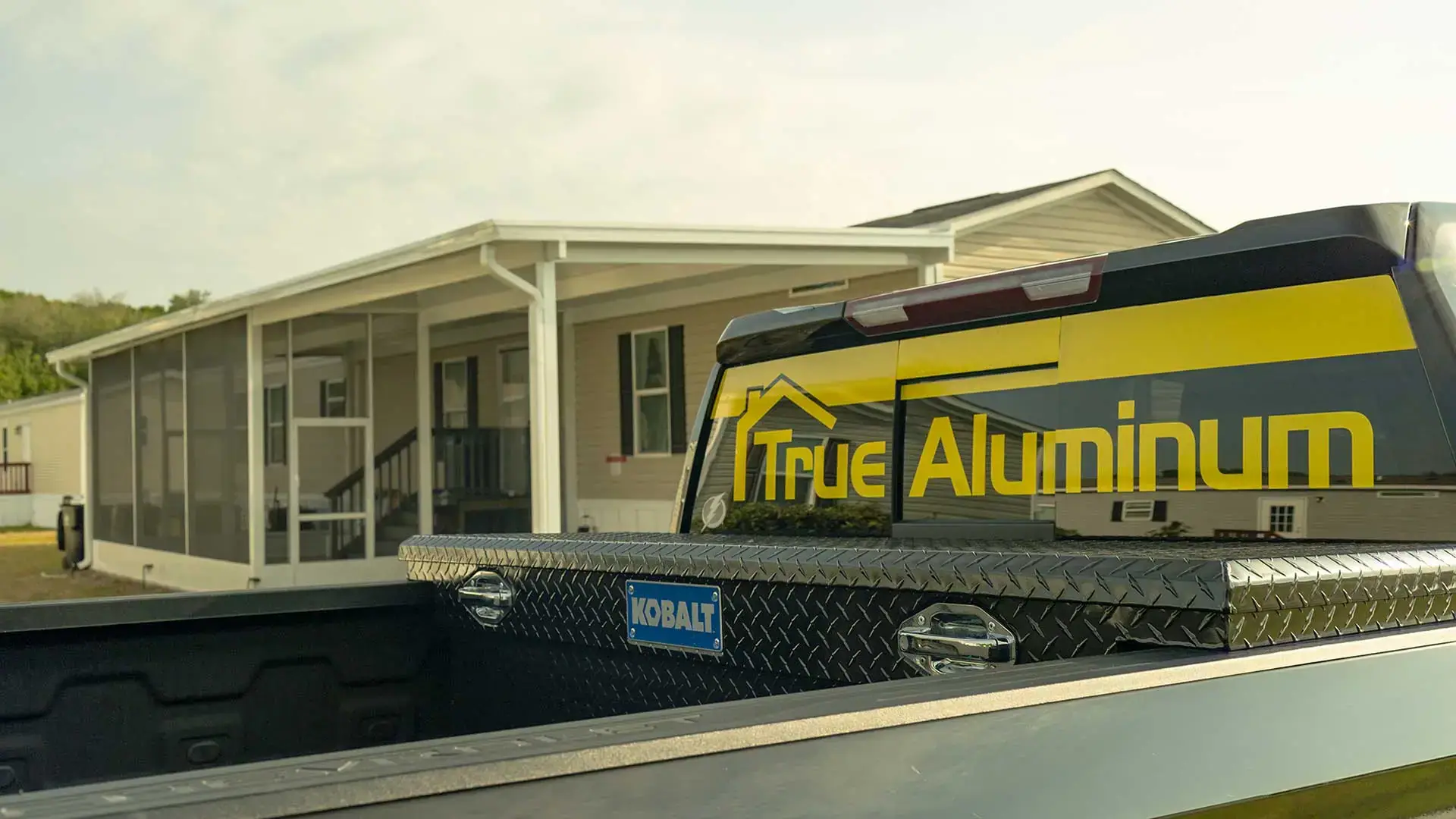
Your porch and swimming pool are the perfect places to enjoy the summer outdoor weather.
However, one issue many people experience in outdoor areas is the inconvenience of dealing with dirt, dust, and bugs.
This might have resulted in you wanting to screen your porch.
You must consider several things before calling the professionals, but the most important is permits.
As one of the top-rated screen enclosure companies in Florida, here are some things we think you should know about permits before screening in your porch.
Is It Mandatory To Obtain A Permit Before Screening In Your Porch?
Whether you want to screen in an existing or new porch, you must have the proper permits.
These permits ensure the project’s safety, the project complies with the building codes, and protects the value of your property and your neighbors’.
At True Aluminum, we handle the whole process for you.
From the application to the permit, as well as any associated fees.
The Rule, In The Words Of The Building Departments
Two Polk County jurisdictions publish the same test in almost identical language, and it is the sentence that decides your project.
The City of Lakeland requires a permit for “screening of any space that requires structural or infill framing to be added.” Unincorporated Polk County’s Building Division FAQ says the same thing: a permit is required for “screening of any space, which requires structural or infill framing to be added.”
Polk County also names the one common job that does not need a permit: “screening with like material in an existing structure.” That is a straight rescreen. If your frame is fine and you are putting new mesh in the same channels, that is rescreening, not new construction.
So the line is framing. New posts, new beams, new infill members to hang screen on means a permit. Same mesh back into an existing frame generally does not, in unincorporated Polk County.
About That $7,500 Exemption You May Have Read About
This one is going around, and it is being repeated wrong, so read this part carefully before you skip a permit on somebody’s advice.
The exemption is real. It is not a Lakeland rule. It is state law: Section 553.79(1)(g), Florida Statutes, as amended by CS/CS/HB 803, effective July 1, 2026. It requires every local government that issues building permits to exempt the owner of a single-family dwelling, or that owner’s contractor, from pulling a building permit for work valued under $7,500 on the owner’s property.
Here is the part that gets left out. The same statute excludes “any electrical, plumbing, structural, mechanical, or gas work performed on property containing a single-family dwelling,” and it excludes property in a flood hazard area. A screen enclosure or a pool cage is a structural aluminum assembly. Structural work is excluded at any dollar value.
Which means a $5,000 screen enclosure does not qualify. Plan on a permit. The statute also says projects cannot be split up to get under the threshold, and where the exemption does apply, the owner or contractor has to submit a written request with a copy of the contract to the local enforcement agency first.
If a bidder tells you your enclosure slides in under $7,500 so you can skip the permit, that is your signal to get a different bidder.
What Does The Permit Entail?
The permits’ requirements and obligations in Florida vary by county and city.
In some counties, for example, the permit might require that the project includes a digital engineering and drainage plan, while other counties might require neither.
As Contractors that are familiar working throughout the Central Florida area, we know the various permit requirements.
It is important to work with a company that is licensed and experienced in this area.
The Engineering Behind The Application
Screen enclosures in Florida are engineered structures, and the code has a specific pathway for them. Under the Florida Building Code they can be designed under FBC Building Section 2002, or built to the Aluminum Association of Florida’s Guide to Aluminum Construction in High-Wind Areas.
The design wind speed comes off the code’s wind speed map for your specific address, and screen enclosures use the Risk Category I map rather than the map used for the house itself. Anyone who quotes you one wind speed for all of Polk County is guessing. The contour lines run through the county, so the number changes across town. We size the frame to whatever the map calls for at your lot.
In Lakeland, screen rooms and pool cages go through as a Residential Addition, and that checklist calls for a complete set of plans signed and sealed by an architect or engineer. That is a real line item on the job, separate from the permit fee itself.
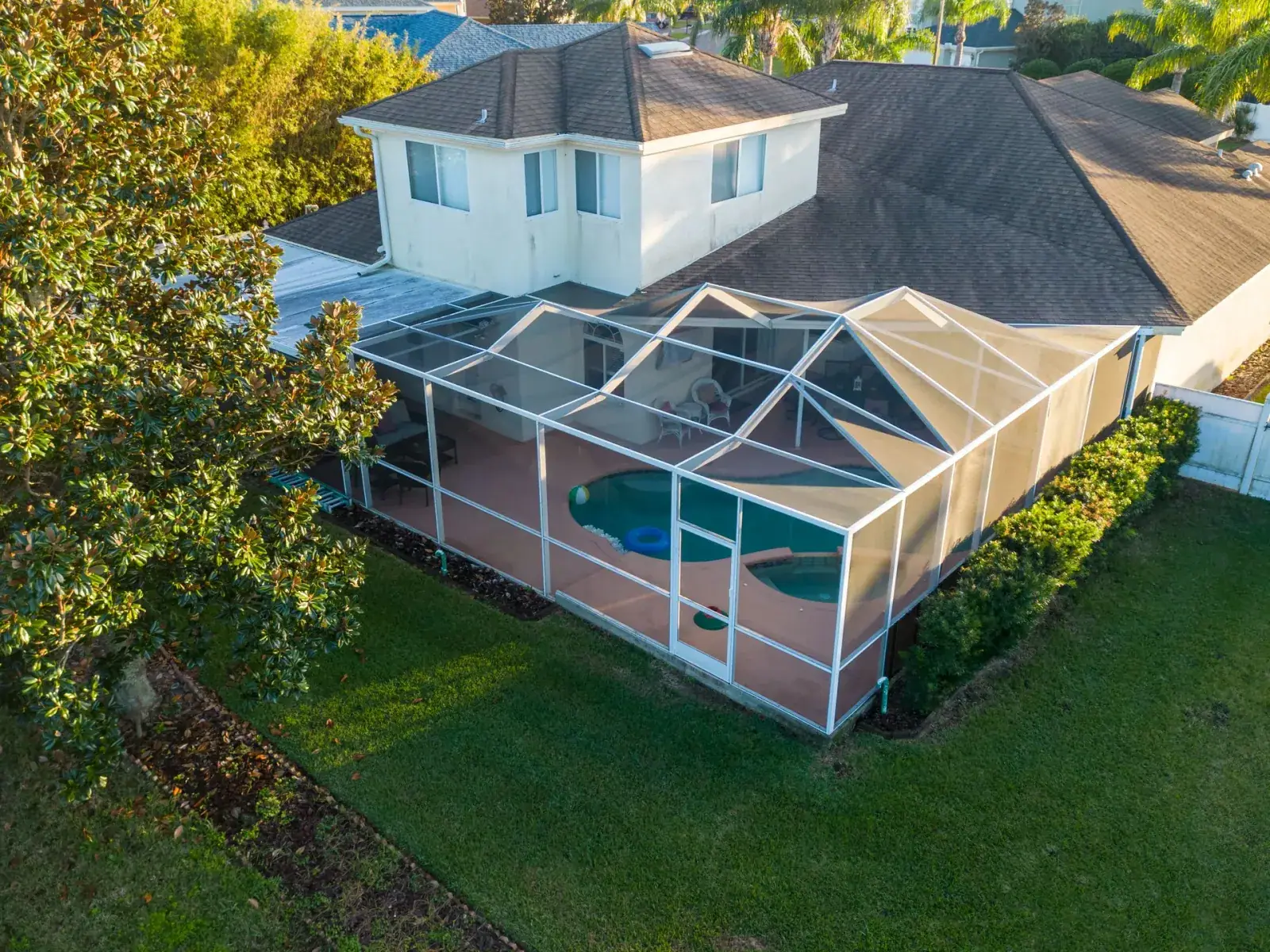
One more thing worth knowing if the enclosure goes around a pool. Under the Florida Building Code, a standard screen enclosure can count as all or part of your required pool barrier and is treated as a nondwelling wall. It only counts if it meets every barrier requirement on its own, including height, no gaps a small child can get through, and self-closing self-latching doors. The inspector signs off on that.
A full glass sunroom is a different permit path than a screen enclosure, because you are adding conditioned space rather than a screened structure. Carports and other attached aluminum structures run through the same residential accessory permitting as a screen room. And if the slab has to be extended or repoured with pavers before the frame goes up, that work gets sequenced into the same job.
Which Office Issues Your Permit
There is no single Florida screen enclosure permit. The office that handles your job depends on which side of a city line your house sits on, and each one runs its own fee schedule and its own portal.
City of Lakeland. Applications go through iMS, the city’s online permitting and inspection system, which replaced eTRAKiT in January 2024. Signed and sealed plans get uploaded separately through ePlan. Screen rooms and pool cages are processed as Residential Additions. Lakeland publishes its fee schedule, so we can show you the math before you commit (see below).
Unincorporated Polk County. Handled by the Polk County Building Division, not the city. The permit rule is the one quoted above: framing added means a permit, like-material rescreen does not. Polk sets its construction permit fees by county resolution based on the value of the work. We do not publish a Polk dollar figure here because the most recent fee resolution we could confirm dates to 2017 and we cannot verify it is still current. Ask the Building Division for the number on your valuation, or we will pull it as part of your quote.
Plant City. Plant City is in Hillsborough County, not Polk, which trips up a lot of homeowners searching for Polk County requirements. The city permits screen rooms as a residential accessory structure, in the same category as carports, garages, storage buildings, and pools, and sets the fee from the value of the work. The Plant City Building Department publishes the current schedule and confirms the amount for your project. Homeowners in Plant City file with that office, not with Polk County.
Winter Haven. Winter Haven issues its own building permits and publishes its own fee schedule. We are not printing a Winter Haven number here because we could not read the city’s current schedule directly, and a made-up fee helps nobody. We pull the permit and confirm current fees with the Winter Haven Building Department before work starts.
What The Permit Costs
Lakeland is the one Central Florida jurisdiction whose schedule we can quote with a date on it, so here is the actual arithmetic. This is the City of Lakeland building permit fee schedule, current as of June 2026, and the fee is driven by the declared value of the work:
- Valuation $1 to $1,000: $40.50
- Valuation $1,001 to $10,000: $72.00 flat
- Valuation $10,001 to $100,000: $72.00 plus $4.73 per additional $1,000
- Residential plan review: 25% of the building permit fee, minimum $31.50
- State surcharge: 2.5% of the permit and plan review fees
Run the numbers on two typical jobs.
A screen room valued at $8,000. That lands in the $1,001 to $10,000 bracket, so the permit fee is $72.00 flat. Plan review at 25% works out to $18.00, which is under the $31.50 minimum, so you pay $31.50. The state surcharge is 2.5% of $103.50, or $2.59. Total: about $106.
A pool cage valued at $20,000. First $10,000 is $72.00, then $4.73 for each of the ten additional thousands, so $72.00 plus $47.30 equals $119.30. Plan review at 25% is $29.83, again under the floor, so $31.50. Surcharge is 2.5% of $150.80, or $3.77. Total: about $155.
Two honest caveats. Lakeland states that final fees are assessed only after plan reviews are complete, so treat those totals as the arithmetic on the published table rather than a locked number. And the permit fee is not the whole permitting cost: the engineer’s signed and sealed drawings are a separate expense, and Florida contractor sources put permits plus engineering together at roughly $200 to $2,000 on a pool cage project.
Those are general market and published-schedule figures, not True Aluminum prices and not a quote. Call us at (863) 804-6021 and the permit cost for your address goes into your written estimate.
The Notice Of Commencement
If your contract is over $5,000, there is a second piece of paperwork, and it is a recorded legal document rather than a permit.
Section 713.135(1)(e), Florida Statutes, requires the permit issuing authority to make the applicant file a copy of the recorded Notice of Commencement with that office before the first inspection when the direct contract price is greater than $5,000. The City of Lakeland states the same threshold, with a separate $15,000 carve-out for mechanical work.
Separately, Section 713.02(5) exempts improvements with a direct contract price of $2,500 or less from most of Florida’s construction lien provisions. Those are two different rules and they get mixed up constantly. For a screen enclosure, the number that matters to you is $5,000, and above it you should expect to record an NOC.
Practically, most screen room and pool cage contracts clear $5,000, so budget the recording trip into the schedule. We walk homeowners through it.
How Long Permitting Takes
Nobody can give you an honest day count off a blog post, and the ones you see quoted are usually somebody’s best week turned into a promise. What we can tell you is the sequence, because the sequence is what eats the calendar:
- Site measure and design, so the engineer has something real to work from.
- Signed and sealed drawings come back from the engineer. On a straightforward rectangular enclosure this is routine. On an odd footprint or a two-story tie-in it takes longer.
- Application goes into the city or county portal, with the plans uploaded.
- Plan review. This is the variable one. It depends on the office, the season, and whether the reviewer comes back with comments. A revision request restarts your place in line.
- Permit issues, Notice of Commencement gets recorded and filed if the contract is over $5,000.
- Build, then inspections, then final.
Hurricane season and the months right after a storm are the slow stretch, because every enclosure contractor in the county is filing at once. If you are planning a spring project, applying in winter is the cheapest scheduling decision you will make. When we quote your job, we give you the realistic window for your specific office rather than an average.
What About HOA Approval?
Your permit and your HOA are two separate approvals, and passing one does nothing for the other.
Most Central Florida deed-restricted communities run an architectural review committee, and adding a screen enclosure, a pool cage, or a carport is exactly the kind of change they review. A permit from the city does not override a covenant, and the HOA cannot issue you a building permit. You need both.
What generally makes it go smoothly:
- Submit to the ARC early, in parallel with the permit application rather than after it. Review windows are set by your governing documents and they are not fast.
- Send the actual plan set, not a brochure photo. Committees approve dimensions, colors, and screen type.
- Ask specifically about frame color, roof style, and screen color before you order anything. Bronze versus white is the detail that most often comes back rejected.
- Check whether your community restricts the enclosure’s height or how far it can project into the rear setback, which is separate from the county setback.
- Get the approval in writing and keep it. It matters at resale.
If the HOA says no to what the engineer needs structurally, tell us. Roof style and post spacing usually have more than one workable answer.
Can I Screen In My Own Porch?
You can pull an owner-builder permit in Florida for work on your own home. Whether you should is a different question.
The catch is that an owner-builder permit makes you the contractor. You are responsible for code compliance, for the engineering, for the inspections, and for anything that fails later. If the work is actually being performed by someone else and you are the one pulling the permit, that arrangement exists to get around licensing, and you are the one holding the liability when the enclosure comes apart in a storm or the buyer’s inspector finds it at closing.
That is the practical answer to the bid that quietly asks you to pull the permit yourself. Say no.
Straight rescreening is different. In unincorporated Polk County, putting like material back into an existing structure is on the county’s no-permit list, and plenty of homeowners handle a panel or two themselves.
Do You Need A License To Install Screen Enclosures In Florida?
Yes, and it is worth knowing which license class to ask for.
Aluminum structures are their own trade in Florida. True Aluminum holds license SCC131151391, Aluminum Specialty Structures. That is the classification that covers screen enclosures, pool cages, lanais, carports, and aluminum railings.
When you are comparing bids, ask for the license number and look it up. A general handyman, a fence company, or a pressure washing outfit that also “does screens” may not hold the classification that lets them pull your permit. If they cannot pull it, you will be asked to, and you already know how that ends.
Enclosing An Existing Porch
Most of the calls we get are not new construction. They are a homeowner with a covered back porch, a slab, and a roof already in place, asking whether adding screen counts as a project.
It does. Adding screen to an existing covered porch means adding infill framing to carry the mesh, and that framing is the trigger in both Lakeland’s and Polk County’s published rules. The existing roof does not exempt the new work.
The good news is that this is the cheapest version of the job, because the expensive parts, the footers, posts, slab, and roof, already exist. It is also the fastest through plan review, since the structure is simpler.
Worth sizing the porch before you apply, since the footprint drives the engineering, the valuation, and therefore the permit fee. Changing the dimensions after the plans are sealed means new plans.
What Happens If You Screen In Your Porch Without A License?
Some might ignore the permit requirement of the project because a porch looks small or the house was already inspected during construction. While a licensed and certified contractor will not let you skip this step, many try to get away with trying to do it without the permit using an unlicensed contractor - which can be a huge mistake.
Some Of The Consequences You Will Face Include:
- Fines - While fines may differ from one county to the next, you will pay a penalty in addition to the money you paid for the work.
- Demolition of the porch - You may have to tear down what has already been completed! Once your porch is demolished, you have to pay for the permits to get another built and more money for the labor and materials.
- Problems selling the house - When buying a home, many buyers want to ensure the house meets all building codes. Without the permit, your house will remain on the market for a long time, and worst case scenario, it might not sell.
Who Should I Hire To Screen In My Porch?
Many contractors offer porch screening services in Florida, making it overwhelming to select the best.
The most important thing we recommend is that you find a company like True Aluminum that is licensed and insured.
Hiring an unlicensed contractor means you have no resources if they bail on you, or do the job incorrectly.
Also, consider looking the contractor up on the Better Business Bureau website.
This notifies you of any complaints previous clients have had with your contractor and what the contractors did in response.
Finally, you should read clients’ reviews on different platforms to help you know the kind of services to expect.
A screened-in porch helps you avoid dealing with bugs, dust, and debris. In addition to the design and materials you want to use - you should make sure you have the proper permits before screening in your porch in Florida.
This helps ensure it meets your area’s building codes, avoids fines, gets the job done properly and safely, as well as gives you higher chances of selling your house faster in future.
Why Homeowners Hand Us The Permit
- Licensed Aluminum Specialty Structures contractor, SCC131151391
- 5.0 stars across 200+ Google reviews in Central Florida
- A+ rated on the Better Business Bureau
- We file in Lakeland, unincorporated Polk County, Plant City, and Winter Haven regularly, so we know which office wants what
Owner’s Tip from Issac Turpin, CEO: The permit is not the part that costs you money. Skipping it is. We have been called out to enclosures built without one, and the cheapest of those conversations still ended with the homeowner paying twice. Let the contractor pull it, in the contractor’s name, and keep the paperwork with your closing documents.
Get Your Permit Handled
Tell us the address and we will tell you which office it goes to, what the fee looks like on that valuation, and what the realistic timeline is right now. That is a free conversation.
Call (863) 804-6021 or request a quote online, and we will handle the application, the sealed drawings, the Notice of Commencement, and the inspections from start to final.
Planning a screen room or lanai specifically? Start on the Screen Rooms & Lanais page. Enclosing a pool? See Pool Cages. Already have an enclosure you want maintained instead of replaced? Look at the True Home Membership.