

Seamless Rain Gutters in Central Florida
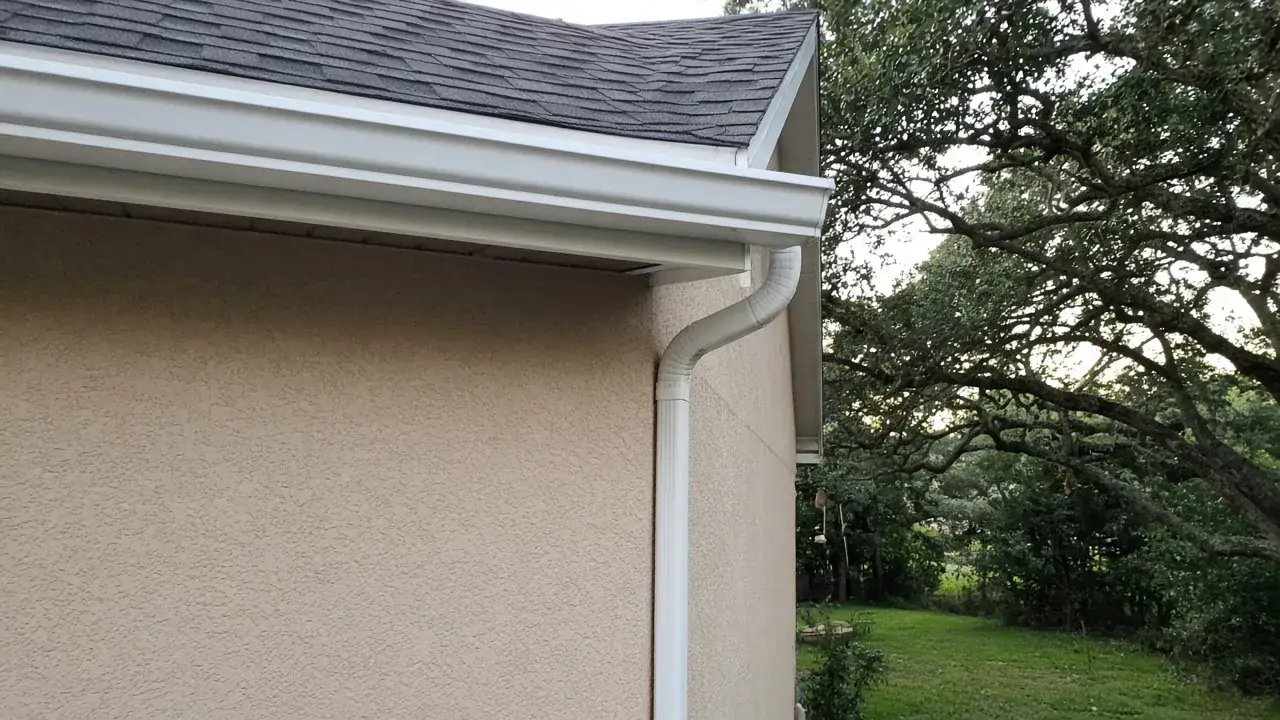
True Aluminum hangs seamless aluminum gutters in Lakeland, Plant City, Winter Haven, and the rest of Central Florida. House runs are 5 inch or 6 inch. A super gutter on a pool cage is a different piece, and it can be larger.
The full service write-up, including price bands and the permit note, is on the gutter installation page. This page is the install itself: where the water goes, what happens on a pool cage, and when the fascia has to be fixed first. License SCC131151391. Call (863) 804-6021.
5 Inch or 6 Inch Seamless Gutters
We cut seamless aluminum on site in one run, so a long wall has fewer joints that can open. The choice is 5 inch or 6 inch. A 5 inch trough is enough for a small roof plane. A wide plane, or a roof that dumps into one run under oak canopy, wants 6 inch so the middle of the gutter does not overflow in a summer storm.
Color is matched to the trim. White and bronze are the usual Lakeland choices. Hidden hangers hold the pitch. The pitch is a small fall toward each outlet, not a gutter that looks dead level from the yard. If the fall is flat, water sits, mosquitoes breed, and the hanger screws rust at the water line.
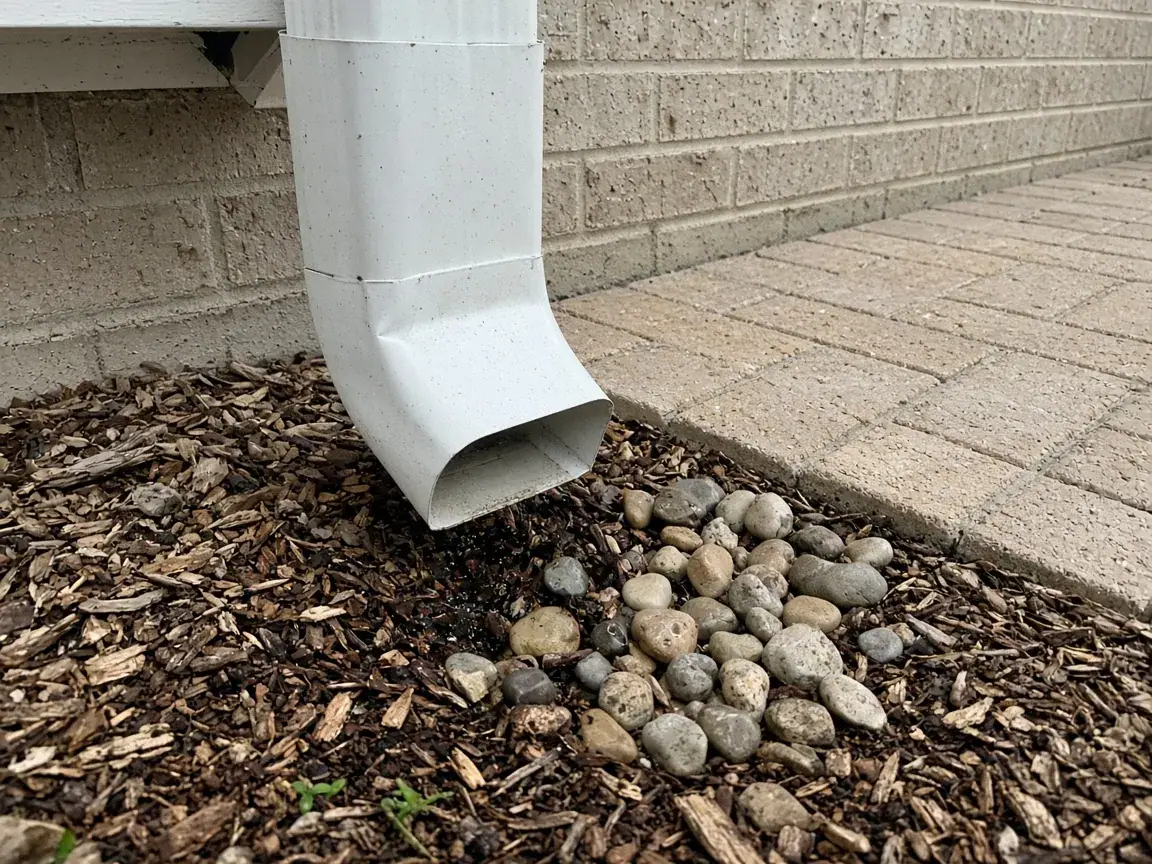
Downspouts are placed so the water leaves the slab, not so the outlets look even from the street. Two outlets on a long wall move the storm better than one outlet at the corner. The outlet in the photo is the part people forget: if it dumps on the pavers, the gutter only moved the problem six feet.
The fascia is checked before new hangers go in. Soft wood is a roof-edge repair, and it gets handled first. We do not hang new metal on rotten board. If the old gutter pulled the fascia away from the truss, that gap gets closed before the new run goes up.
Gutters on a Pool Cage or Lanai
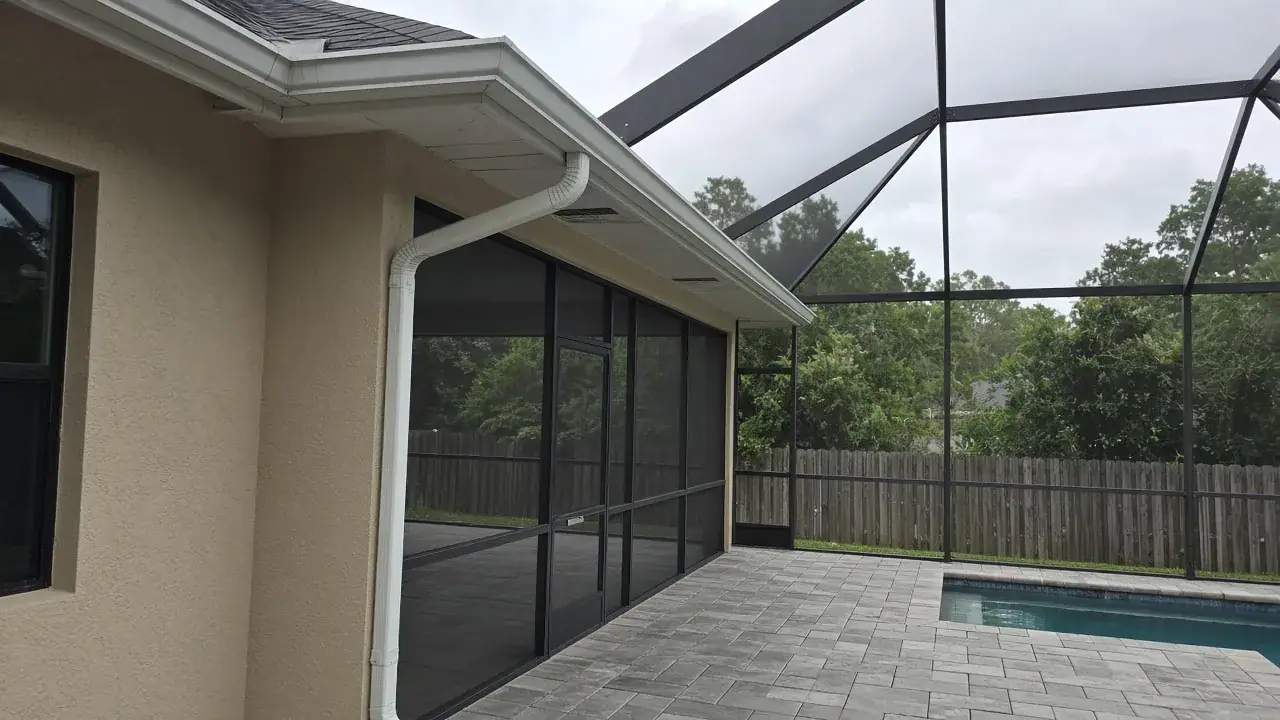
A gutter on the house eave and a gutter on a pool cage are different pieces. The house gutter is the 5 inch or 6 inch run above. A super gutter on a cage is a structural beam that also carries water, and it prices as part of the enclosure, not as a house gutter. Public figures on the gutter installation page put that beam around $1,500 to $2,500 installed. That is a market range, not a True Aluminum quote.
On a lanai or a patio enclosure, the downspout has to land outside the screen. Water that drops inside the pavers sits under the cage, stains the deck, and keeps the footer wet. We mark that outlet at the measure, on the outside of the screen, and we do not hide it behind a post where you cannot see it clog.
If the cage, the lanai, and the house roof all shed onto the same corner, say so on the first visit. One downspout cannot take three roofs. We split the runs so the house eave has its own outlet and the cage beam has another.
A cage that already has a beam can sometimes keep that beam and only change the outlet. If the beam is chalky, open at the seams, or pulling off the house, the beam is part of the enclosure repair, not a Saturday gutter swap.
Signs You Might Need New Gutters
Overflow in the middle of a run usually means the trough is too small or the pitch died. Overflow only at a corner usually means that outlet is clogged or there are not enough downspouts. Those are different repairs. A new gutter does not fix a corner that only needed a cleanout.
Rust holes, a run that has pulled off the fascia, and a bed washed out under the drip line are replacement signs. So is white chalk on aluminum that wipes off on your hand: the coating is gone and the metal is next. Stains on the stucco under the eave mean water has been missing the trough for a while.
Sag between hangers means the hangers are too far apart or the screws have let go of the board. We add hangers on a sound fascia. We replace the board when the screws no longer bite. Age alone is not the test. A 15-year gutter that still pitches and still holds water can stay.
How Gutter Installation Works
The first visit is a measure, not a guess from the street. We walk each roof plane, the fascia, and where the water lands now. Old metal comes off if it is staying in the way. The new trough is cut on site so a straight wall is one piece, with miters only at the corners.
Pitch and hanger spacing are set before the metal goes up. Hidden hangers go into solid board. Downspouts are screwed on after the outlets are cut, and the bottom elbow is aimed at mulch, rock, or a splash block, not at the walk. Most house runs are a one-day install. A cage beam is scheduled with the enclosure, not as a Saturday add-on.
Before we leave we run a hose at the high end of each run. If water stands, the pitch is wrong and we fix it that day. A gutter that only looks straight from the driveway can still hold a puddle in the middle.
- Measure the roof area and the fascia
- Cut 5 inch or 6 inch seamless gutter on site
- Set pitch and hidden hangers
- Place downspouts so water leaves the slab
- Hose-test each run before we leave
Upgrade With Leaf Protection and Gutter Guards
Oak, pine, and roof grit are the usual clogs in Lakeland, not a northern leaf season. A guard keeps the big debris on the roof so the trough stays open. It does not make the gutter maintenance-free. Fine grit still settles, and a guard that is packed solid will overflow the same way an open gutter does.
We put guards on a new run when the trees are close to the eave. On a roof with almost no canopy, the guard is optional and we say so. Mesh that is finer than the debris you actually get is harder to rinse. We match the guard to the trees, not to a catalog name.
A guard does not fix a rotten fascia or a gutter with no pitch. Those get corrected first. If the soffit is open or the fascia is soft, that wood is part of the same visit.
Gutter Systems for Every Property
A single-story house with a simple hip roof is the common job: one or two colors, 5 inch or 6 inch, and downspouts at the corners that already slope away from the slab. A two-story needs longer drops and hangers that reach sound wood, not just the decorative trim.
Townhomes and duplexes share a wall, so the outlet cannot dump on the neighbor's side. We stop the run at the property line and send the water to your yard. Mobile homes often have a thin fascia; if the board will not hold a screw, the edge gets rebuilt before the gutter goes on.
Small commercial fronts and new construction use the same aluminum. The difference is access and how many roof planes meet one corner. Remodels usually mean tearing off a sectional gutter with leaking joints and replacing it with one seamless run.
Where We Hang Gutters
The shop is at 4000 N Frontage Rd, Plant City, FL 33565. The Lakeland listing is 2829 Badger Rd #19, Lakeland, FL 33811. Most gutter runs are in Polk County and the cities next to it. License SCC131151391. Hours are Monday through Saturday, 9:30 AM to 7:00 PM. Sunday is closed.
Lakeland, Plant City, Winter Haven, Brandon, Wesley Chapel, Zephyrhills, Davenport, and Auburndale are the usual drives. If the house is outside that loop, call and we will say whether the measure is in range that week.
Need More Than Gutters? We Also Build
A gutter job often shows the next problem. Water that missed the old trough may have stained the lanai pavers, or the cage beam may be the piece that is actually failing. We build screen rooms and lanais, pool cages, patio enclosures, carports, and sunrooms. The gutter on those structures is planned with the frame, not bolted on after the screen is up.
If you only need the house eave, that is the whole job. We do not turn a gutter measure into a cage bid unless you ask. The pages for those builds are linked from the service menu.
Schedule the Measure
Call (863) 804-6021. We measure the fascia and the roof planes, then we give you a number for 5 inch or 6 inch seamless gutter. Tell us if a pool cage or lanai shares that corner. License SCC131151391.
Price bands, the permit note, and the super gutter figure are on the gutter installation page. A house gutter by itself is usually not a permit job. A super gutter that carries a cage is permitted with the enclosure.